
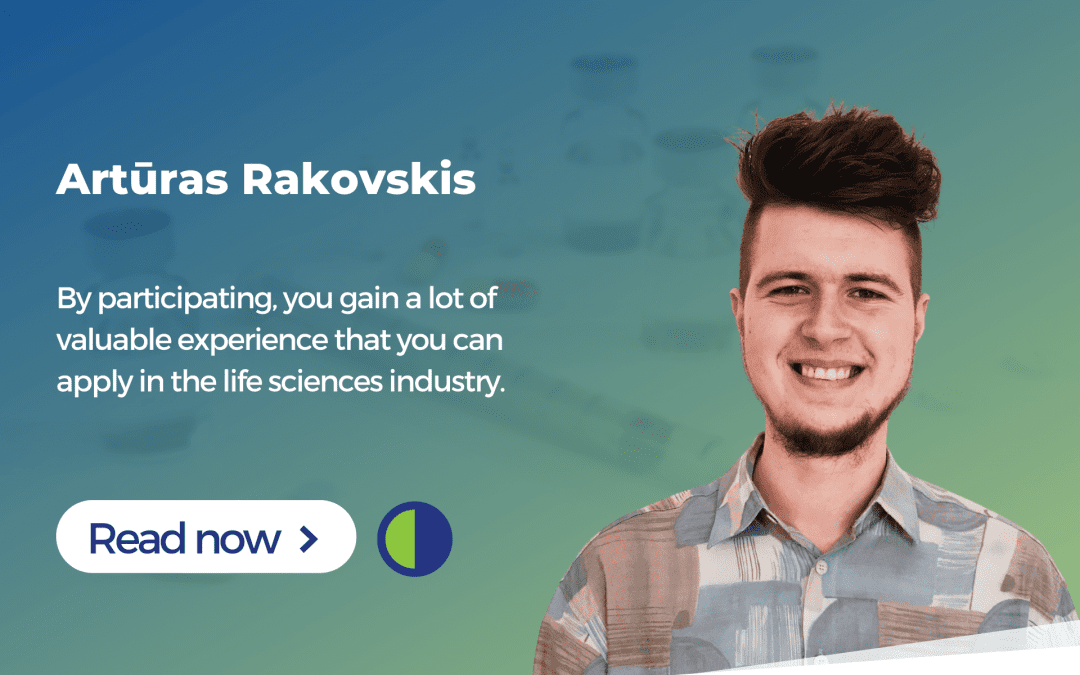
Why did you participate in the Biomapas Academy?
Everything started when I had a trip to a career fair during my studies. This was the first time I met Biomapas in person as there were several lecturers that presented the company itself and its activities. I remember thinking that I would like to work with this team as it piqued my interest.
Later, when I was working on my master’s degree, I came across an advertisement on social media for the Biomapas Academy. I already knew that I wanted to learn more about the pharma industry and was interested in various opportunities, so I applied for this opportunity.
How was your experience during the three months?
The Academy was a continuous cycle spanning several months of interesting lectures from true professionals with extensive knowledge. During this short time, I learned a lot about product development, research, safety information and its systems, different possible roles and their responsibilities, and new opportunities where young specialists can grow and find their place in the life sciences industry.

What did the future hold for you after the Academy?
A while after the Academy, I officially became part of Biomapas and its big family! With my background being an MPharm, I was always interested in drug safety. Therefore, I am working in the Pharmacovigilance Department as a Pharmacovigilance Project Management Assistant. I must say there are many interesting things to learn and experience that I am looking forward to with my team.
What would you say to the future participants?
If you are thinking about participating in the Academy, do not hesitate. Being an alumnus, I can say that you will definitely see the pharma industry from within. It will broaden your understanding; you will gain needed knowledge and experience in life sciences and will be able to apply that information working in your chosen field. I hope to see you at Biomapas!

Biomapas Academy
What is Clinical Research? Regulatory Affairs? Pharmacovigilance?
CMC: Effective Writing of IND and IMPD
Do we truly know how to ensure IND or IMPD Quality (CMC) part is written in good quality, consistent and clear technical language? How to effectively manage the writing process? In this article, I will focus on these questions and the initial IND/IMPD, required to start clinical investigations in humans. Furthermore, I will provide the key features and practical advice on how to deliver effectiveness. Firstly, we have to define the team in order to understand if the organization has capabilities to do CMC writing in-house or needs to outsource.
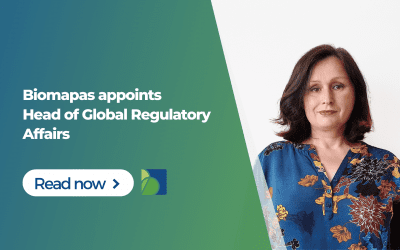
Biomapas appoints Head of Global Regulatory Affairs
May 2020 – Olga Bernardova joins Biomapas as Head of Global Regulatory Affairs to lead the regulatory affairs department and to ensure the best processes and means to serve Biomapas growth and international expansion. As a functional and full outsourcing solution provider, with offices in Lithuania, Switzerland, Sweden, Russia, Georgia, Ukraine, Poland and Kazakhstan, Biomapas continues to expand its international team and further increases capabilities for client-oriented solutions.
Regulatory Documents Translation Process – How to Ensure Consistency and Correctness
Mistranslation of regulatory documents such as a summary of product characteristics, product information leaflets and instructions for use, could have a negative impact for the company and most importantly could lead to serious consequences to a patient’s health. In 2007, as a result of inaccurate translation, 47 patients had badly implanted knee prostheses. An outer package labelled in English included different information.
Biomapas Opens a New Office in Kazakhstan
Biomapas has announced the opening of a new office in Central Asia. The new location in Kazakhstan strengthens Biomapas presence in the CIS region and further improves flexible and reliable clinical, regulatory and pharmacovigilance service delivery to the global life science industry in emerging markets. As a functional and full outsourcing solution provider, with a new office in Almaty, Biomapas continues to expand internationally.
MAH is the Key to the Pharmacovigilance: 10-year Lithuania Statistics
Even though the drug safety and reporting of the adverse effects is the responsibility of all Health Care Providers, pharmacists and patients, statistics show that the one in charge is Marketing Authorization Holder. During the National semi-annual conference „Pharmaceutical News“, State Medicines Control Agency presented the statistics of suspected ADRs reporting in Lithuania.
Running a Clinical Trial in Ukraine
Despite the fact that Ukraine is the largest country in Eastern Europe with a large population of treatment-naïve patients, well organized public health care sector and significant number of medical sites accredited for clinical trial conduction, country has utilized only 15% of its current potential for hosting clinical trials. During 2017, the European Medicine Agency (EMA) gave positive recommendations on 94 new drug applications and 49 of them were tested in clinical trials in Ukraine. During the same year, the US FDA approved 151 new drugs, and 28 of them were also studied in Ukraine.

Biomapas appoints Head of Global Pharmacovigilance
March 2020 – Clinical, regulatory and pharmacovigilance solution provider to the global life science industry, Biomapas, appointed leading pharmacovigilance professional Martijn van de Leur as Head of Global Pharmacovigilance. With offices located in Lithuania, Switzerland, Sweden, Russia, Georgia, Ukraine and Poland, Biomapas provides services in 60+ countries across 4 continents. As a functional and full outsourcing solution provider, Biomapas continues to strengthen its international team and geographical coverage of its services globally.
Regulatory Affairs Outsourcing: From Baby Steps in Cost Savings to Long-Term Partnerships
The trend of outsourcing continues to grow in the life science industry. Global regulatory affairs outsourcing market was valued at US $5.7 billion in 2018, and is expected to witness a compound annual growth rate of 11.9% over the period to 2026. Regulatory affairs outsourcing may vary in extent (from stand-alone service to full-scope solution), length (project based or long-term partnership with selected vendor), model (insourcing a dedicated expert for specific project or functional service provision), etc.
What is a Safety Signal?
Occasionally we see the information of a safety signal for medical product, but what does it really mean? We can describe the safety signal as an indication for new and significant safety-related data for a marketed product. The new data could indicate a new potentially causal association between an adverse event, beneficial response and a medical product, or a new aspect of causal association that was previously known. Usually, a signal will be relevant for all products with the same active ingredient, including the combination products. Further, let’s look more at the main steps of the safety signal management.
Rx to OTC Switches – 5 Things You Need to Know before Considering a Switch
In the process of marketing authorization, competent authorities classify medicinal products as the subject or not-subject to medical prescription. However, the classification of medicinal products can be reevaluated and changed via a regulated procedure. When considering a switch, many factors like characteristics of market and population, local policies, advertising, confidence in regulatory authorities and other, influence the outcome. Though, the safety of patients has the highest priority. So, what questions should you ask?