So, how do biotech companies build clinical safety capabilities without creating unnecessary operational burden?
This article examines the components of clinical safety management, the requirements before enrolling the first patient, how safety needs change across development phases, and when to consider external clinical safety support.
What Clinical Safety Management Includes
Clinical safety management is about finding, evaluating, recording, and addressing patient safety risks throughout clinical development. In practice, this means monitoring safety in trials, handling adverse events, medical review of safety data, reporting on safety, and keeping clear oversight across studies and vendors.
For biotech companies, clinical safety management is often where operational complexity starts increasing. Even during early-phase trials, companies are expected to maintain structured workflows for handling serious adverse events (SAEs), escalating potential safety signals, and meeting regulatory reporting timelines.
At this point, it is important to distinguish that clinical safety management is not the same as full pharmacovigilance. Yes, clinical safety operates primarily within the context of active clinical development, where rapid decision-making and real-time oversight are essential, but as development progresses, these processes gradually evolve into broader pharmacovigilance systems.
All in all, without a clear structure, responsibilities can quickly become fragmented across clinical teams, CROs, and external vendors. Building a scalable clinical safety model early is less about creating a large department and more about establishing clear ownership, consistent processes, and reliable oversight from the start.
Why Emerging Biotech Companies Struggle to Build Clinical Safety Functions
It is certain that emerging biotech companies don’t underestimate the importance of clinical safety management. But they struggle because safety requirements expand long before the organization is structured to support them internally.
The issue lies in the distribution of responsibilities. Clinical operations, medical, regulatory, and external CRO teams juggle those responsibilities in early development without clear ownership. At the same time, regulatory expectations continue to increase. Even lean Phase I and II programs require structured safety monitoring, reliable reporting pathways, and documented Sponsor’s oversight of external vendors and partners.
Finding the balance is difficult. Building a large internal clinical safety department too early increases operational overhead. While relying entirely on external vendors without sufficient internal oversight creates visibility and compliance risks, as studies become more complex or expand into multiple regions.
So, the core challenge again lies in building a clinical safety function that is scalable, operationally efficient, and aligned with the realities of early-stage development.
What Needs to Be in Place Before First Patient In
Clinical safety management should already be operational before the first patient enters a study. The goal at this stage is not to build enterprise-scale infrastructure, but to establish a minimum viable clinical safety framework that supports consistent oversight once safety data starts being collected.
For emerging biotech companies, this early structure is critical. Safety processes that are unclear, fragmented, or implemented too late often become difficult to scale as studies expand into additional regions, sites, and patient populations.
At a minimum, biotech companies should have:
- Clear workflows for adverse event (AE) and serious adverse event (SAE) handling
- Defined escalation pathways for potential safety signals
- Established reporting timelines and communication structures
- Clearly assigned responsibilities across sponsors, CROs, investigators, and external vendors
- Oversight procedures to maintain visibility across outsourced activities
- Documentation and traceability processes aligned with regulatory expectations
Even when clinical safety activities are outsourced, sponsors remain responsible for oversight. Without clear governance and communication structures, safety management can quickly become reactive instead of controlled.
For biotech companies running early-phase or multi-regional studies, building this foundation early creates a scalable framework that can support increasing operational complexity and expanding pharmacovigilance requirements throughout development.
Building a Scalable Clinical Safety Model
Having examined the challenges in building a clinical safety department, we will now discuss how to establish one effectively.
A scalable clinical safety model maintains internal oversight while leveraging external expertise for operational activities as needed. Rather than building large in-house teams from the outset, companies often combine lean internal leadership with external support for safety monitoring, adverse event processing, and regulatory reporting.
This approach enables biotech companies to adapt as development progresses. Safety operations can expand with study complexity, geographic reach, and regulatory requirements without requiring the organization to rebuild its infrastructure at each stage.
The key is to maintain clear governance, defined ownership, and visibility across all safety activities, regardless of how responsibilities are distributed among internal teams, CROs, or external pharmacovigilance partners.
How Clinical Safety Evolves Across the Drug Development Lifecycle
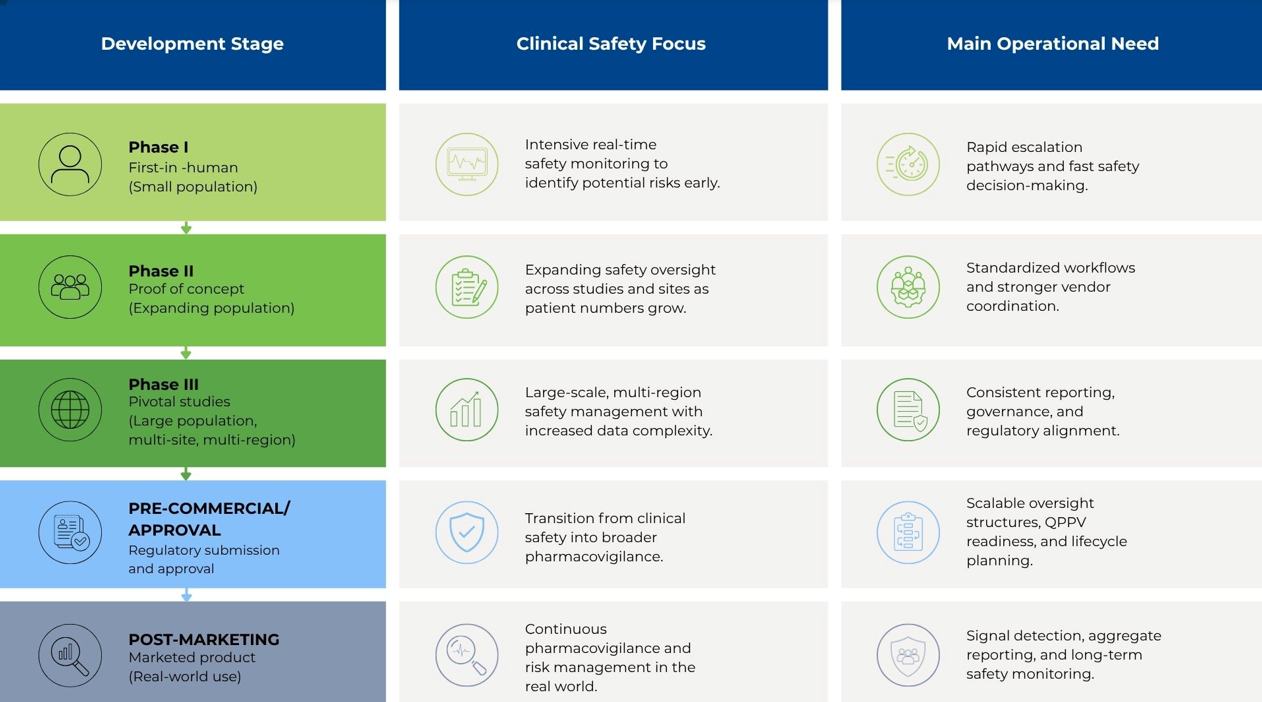
As clinical development progresses, clinical safety management becomes more complex. Early-phase trials focus on intensive safety monitoring and rapid risk assessment, while later-stage studies require broader oversight, multi-region coordination, and advanced pharmacovigilance activities. Early clinical safety structures must be scalable to support growth across development phases and regulatory environments.
As clinical trials progress, pharmacovigilance requirements become more structured and region-specific. What may begin as basic safety monitoring during early development can quickly expand into formal obligations related to aggregate reporting, signal detection, local safety representation, and regulatory submissions across multiple markets.
This shift becomes especially visible in multi-regional studies. While global frameworks such as ICH and e.g. EMA guidelines provide a foundation, local authorities may still apply country-specific requirements for reporting timelines, language, documentation, and in-country pharmacovigilance oversight.
For biotech companies, this often creates a new operational challenge. Safety systems that worked during early-phase development may no longer provide enough visibility, scalability, or regulatory coverage as programs expand internationally.
When External Clinical Safety Support Starts Making Sense
For many biotech companies, external clinical safety support becomes necessary long before commercial launch. As studies expand across sites, regions, and patient populations, the operational workload around safety monitoring, reporting, and oversight increases quickly.
At this stage, relying entirely on lean internal teams can create bottlenecks, delay reporting, or reduce visibility into safety activities. External support allows companies to access specialized expertise and scalable operational capacity without building a large in-house department too early.
This does not mean giving up control. In most cases, the most effective model combines internal oversight with external support for specific activities such as adverse event processing, safety monitoring, aggregate reporting, or regional pharmacovigilance requirements.
For biotech companies running early-phase or multi-regional studies, this approach creates more flexibility while maintaining consistent clinical safety management as development progresses.
Conclusion
Building clinical safety management for biotech companies does not require a large internal department from day one. What it does require is a structured, scalable framework that supports patient safety, regulatory compliance, and operational oversight as clinical development progresses.
By establishing clear workflows early, maintaining visibility across safety activities, and combining internal oversight with targeted external expertise where needed, biotech companies can build clinical safety capabilities that grow alongside their programs without creating unnecessary operational complexity.
As trials expand into larger patient populations and additional regions, this scalable approach becomes essential for maintaining consistent safety management, supporting pharmacovigilance readiness, and keeping development timelines on track.