

Is medical information (MI) and pharmacovigilance (PV) integration still optional? The short answer is no. Regulators expect every enquiry, report, and safety update to connect seamlessly. When these functions work in isolation, gaps appear, and those gaps create risk, slow responses, and weaken compliance.
Integration changes that. It links both functions into one framework, with shared governance, clear workflows, and validated systems that keep data accurate and traceable. For life science companies, it becomes the foundation for faster decisions, fewer errors, and stronger safety oversight, while preserving the independent value of each function.
How integrated medical information and pharmacovigilance create one continuous compliance workflow.
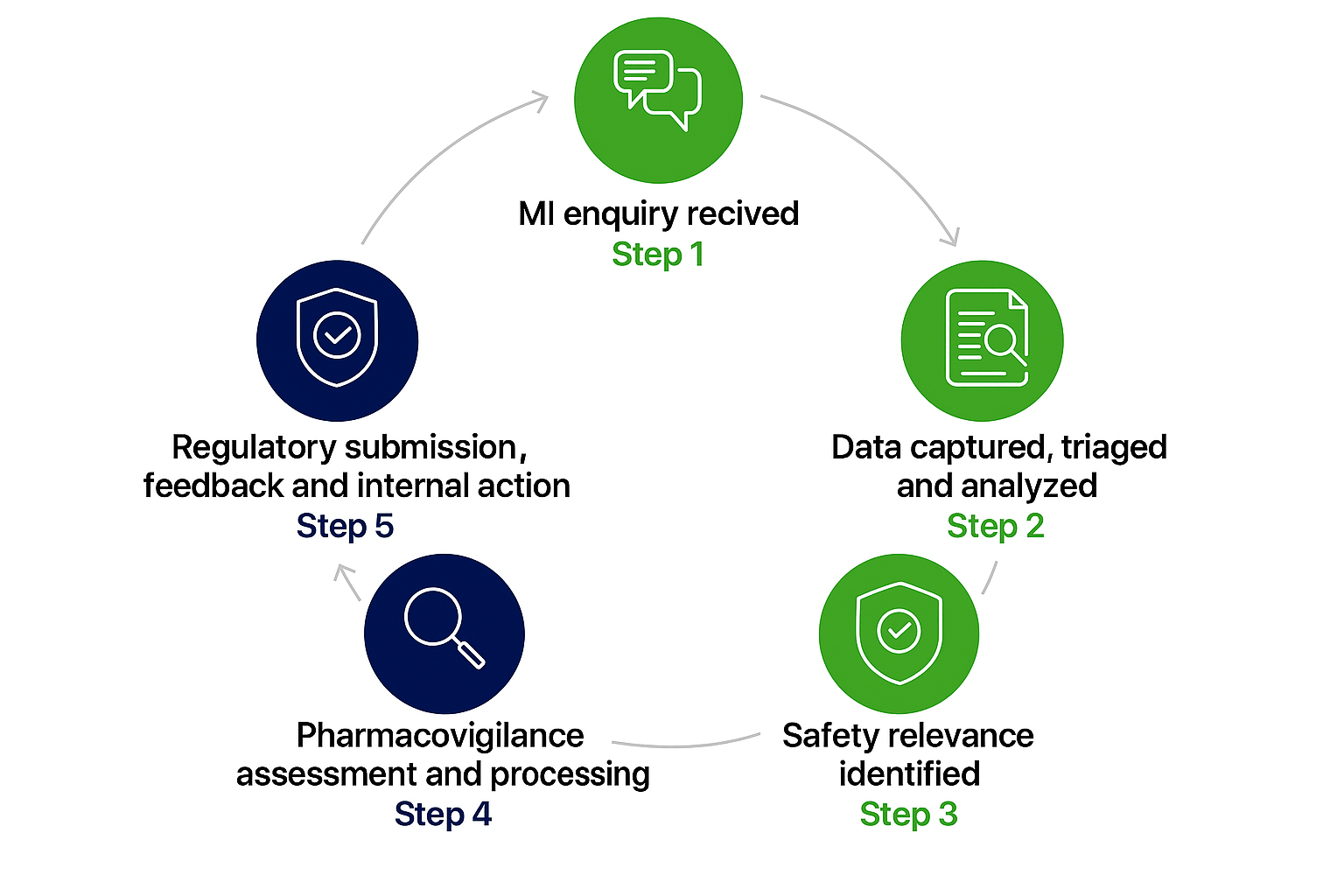
This article explores how integration works in practice: how medical information feeds pharmacovigilance, how technology strengthens the connection, and how global and local teams can manage compliance together through a single, integrated system.
What medical information contributes to an integrated framework
Medical Information functions independently or is integrated with PV, while generating structured insights from external enquiries that support both compliance and business decision-making. Every question from a healthcare professional or patient creates a data point that can reveal how a product performs in the real world. Capturing that data correctly is where compliance starts.
Medical information services handle enquiries, document responses, and track product details that may relate to safety or quality. They serve as the first line of contact between your company and the people using your products. Through these operational activities, Medical Information generates structured, real-time insight into how products are understood and used in clinical practice. Each interaction can uncover potential adverse events or product issues that pharmacovigilance teams need to review when safety relevance is identified and managed through defined MI–PV handover processes.
When managed through structured and validated systems, Medical Information data becomes reliable, traceable and can be analyzed to identify emerging trends, recurring questions, and potential quality or compliance concerns, independently of formal pharmacovigilance reporting.
These insights support both patient safety and business decision-making, enabling early implementation of corrective or preventive measures, updates to communication strategies, content revisions, or internal reviews before issues escalate into regulatory or safety events.
Medical Information supports:
- Early identification of trends and quality issues
- Proactive safety and risk awareness
- Informed business decisions based on real-world enquiry data
- Early action to mitigate potential safety, quality, or compliance risks
In the next section, you will see how pharmacovigilance takes this information further, turning it into the safety intelligence that keeps patients protected and companies compliant.
How pharmacovigilance translates information into compliance
Once medical information captures the right data, pharmacovigilance turns it into action, translating details into decisions. The main question that pharmacovigilance specialists ask is: What do these data mean for product safety? Their work ensures that every potential risk is evaluated, documented, and reported in line with regulatory requirements.
In practice, pharmacovigilance teams:
- Collect and evaluate adverse event data from multiple sources to identify potential safety signals.
- Review safety trends across studies and markets to detect emerging risks early.
- Prepare and submit reports to health authorities within required timelines.
- Manage global safety systems that track information in real time.
- Align submissions with regional regulatory standards, including EMA, FDA, and EAEU requirements.
- Maintain precision and consistency, since even a single late or incomplete report can affect compliance.
Precision and consistency are critical, as gaps or delays introduced at the MI–PV interface directly affect regulatory compliance. Integration across systems, teams, and processes mitigates these risks by enabling timely information transfer, clearly defined ownership, and consistent application of controlled workflows.
In the next section, you will see how these two functions connect, forming a single, efficient process that captures, evaluates, and communicates safety data without gaps.
The integration process – where MI and PV meet
Medical Information and Pharmacovigilance intersect at the point where external interactions generate data with potential safety relevance. Regulators expect this interface to be governed by clearly defined processes, shared oversight, and validated systems that ensure consistency, traceability, and compliance. At this intersection, patient or healthcare professional enquiries transition into verified safety data through a single, continuous process in which data flow, communication, and accountability are aligned.
It begins when a medical information specialist receives an enquiry that contains a potential adverse event. The details are logged, validated, and passed to the pharmacovigilance team through a shared system. From there, the event is assessed, coded, and entered into the global safety database. Both functions operate under aligned standard operating procedures and shared governance, ensuring end-to-end traceability from first contact through regulatory submission and follow-up.
For example, a physician might call to clarify dosing after an unexpected side effect. The medical information team records the enquiry, flags it as a potential safety issue, and sends it directly to pharmacovigilance. Pharmacovigilance then performs medical evaluation and documents the event in line with defined regulatory requirements and timelines, while subsequent actions are defined, tracked, and addressed through established processes within a single source-of-truth system that enables end-to-end visibility of the case journey.
This integration transforms collaboration into a single, inspection-ready compliance pathway.
Strategic and regulatory value of MI–PV integration
When medical information and pharmacovigilance integration is implemented effectively, the value shows up in measurable results. This is not just about smoother communication between teams, but about clear business outcomes that strengthen compliance, reduce risk, and improve operational agility.
Shared systems ensure that safety-relevant information is captured once, maintained in a validated environment, and remains traceable throughout the end-to-end process. Aligned teams operating under common governance and standard operating procedures ensure consistent decision-making, while integrated processes prevent duplication, ambiguity, and manual handoffs that could otherwise lead to delays or data loss.
True integration is tested when you move beyond a single market. Maintaining global oversight and local compliance requires a structure that can adapt to multiple authorities, languages, and expectations without losing consistency. That balance is where an integrated MI-PV system delivers its full value.
The most tangible benefits of integrated MI and PV services include:
- Faster identification and processing of safety-relevant information
- Reduced data discrepancies through validated workflows
- Consistent documentation that withstands audits and inspections
- Consistent communication and messaging worldwide
- Lower operational costs by removing duplicate work and redundant systems.
- Scalability as your pipeline grows, allowing resources to expand or contract without restructuring.
- Improved oversight and decision-making across global and local operations
- Early detection of trends, quality issues, and emerging risks
From a regulatory perspective, this integration strengthens inspection readiness by ensuring complete documentation, preserved audit trails, and transparent decision-making across functions.
From a strategic perspective, it enables earlier risk identification, improved data quality, clearer oversight, and more timely business and safety decisions across global and local operations.
For leadership and quality functions, this structure demonstrates compliance maturity and enables earlier, better-informed business and safety decisions.
The next section explores how technology turns these advantages into a sustainable system that scales with your company’s growth.
Technology as the enabler of integration
Without digital tools, the connection between medical information and pharmacovigilance would rely on manual transfers, spreadsheets, and delayed communication. With the right infrastructure, data flows automatically from the initial enquiry to the final safety report, reducing errors and ensuring every record is traceable.
A strong example is Nexentria’s En3, Biomapas’ validated platform for integrated medical information and pharmacovigilance management. It automates omnichannel case intake, captures every decision and documents actions, and connects global and local teams within one secure environment. The system supports multilingual case handling, includes safety reporting workflows, centralized content management with localization of responses’ capabilities, generates automated audit trails, and maintains full compliance with EMA, FDA, and GDPR requirements.
Technology transforms integration from a process goal into an operational reality, supporting both scalability and inspection readiness.
For biotech leaders, technology like Nexentria’s En3 provides the control and visibility needed to manage compliance confidently as operations expand.
Outsourcing integration – a scalable path for biotech
For most biotech companies, building internal systems for medical information and pharmacovigilance operations is neither practical nor cost-effective. Each function requires validated technology, trained personnel, and continuous alignment with regulatory changes. Outsourcing solves this challenge by providing immediate access to both expertise and infrastructure without the need for large internal teams.
Through pharmacovigilance and medical information outsourcing, integration becomes a managed service rather than a burden. Instead of maintaining two departments, you gain one coordinated framework where every process, system, and report follows the same standards. Governance remains transparent, and oversight is centralized, so you retain control while partners handle execution.
Key advantages of the integrated outsourcing model:
- Flexibility to scale resources up or down as your portfolio grows.
- Consistency through shared quality systems, localized global content, and global standard operating procedures.
- Speed in response times and inspection readiness.
- Cost efficiency by replacing fixed overhead with activity-based support.
At Biomapas, this approach is already built into our service model. Our teams combine global oversight with local presence, using unified platforms like Nexentria’s En3 to manage compliance end to end. In practice, this model delivers predictable performance, measurable results, and genuine peace of mind.
Conclusion – integration as a strategic advantage
True medical information and pharmacovigilance integration go beyond process efficiency. Medical Information and Pharmacovigilance serve distinct but complementary roles within a shared compliance framework.
Medical Information, as a standalone function, supports patient safety and business strategy through early insight, trend identification, and proactive decision-making. Pharmacovigilance ensures that safety-relevant information is identified, collected, medically evaluated and monitored, and reported in accordance with regulatory requirements.
When both functions operate through aligned systems, teams, and processes, data flows without interruption, risks are identified earlier, and responsibilities remain clear and defensible.
Compliance becomes a structured, defensible control model that protects patients while supporting sustainable business decisions.
At Biomapas, integration is at the core of our approach. Through Nexentria’s En3 and global MI-PV expertise, we help companies scale safely, stay compliant, and protect patients worldwide.


